

Just Pé Jonasse
PhD candidate
Supervisor
Promotor
Employed since
dr. Jessi van der Hoeven
prof. dr. Petra de Jongh
September 2022
Phone
Room
Unravelling the influence of lattice strain on the catalytic performance of core-shell catalysts
Many modern catalytic systems still make use of effective but expensive precious metals like platinum (Pt). Core-shell catalysts are materials where a catalytically active metal forms a homogeneous shell around a core of a cheaper and more abundant metal1. In addition to minimizing expensive material use, the core-shell system can also exhibit enhanced catalytic performance relative to their monometallic counterparts2. This enhanced performance is typically ascribed to two effects, I) lattice strain in the shell material and II) electronic interactions of the core with the shell material3,4. The lack of a core-shell model system to decouple these parameters makes fundamental understanding of the influence of lattice strain and electronic interactions on the catalytic performance difficult.
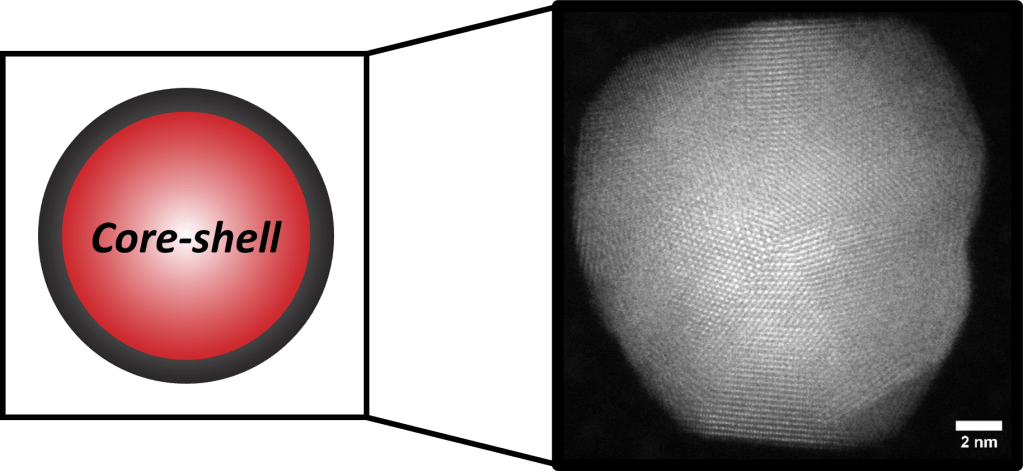
In this project, core-shell systems (Fig. 1) based on noble metals for the investigation of lattice strain are developed using colloidal synthesis. Utilizing advanced characterization techniques such as high-resolution electron microscopy and energy-dispersive X-ray spectroscopy, the core-shell catalysts will be investigated down to the atomic level. The developed strained core-shell catalysts will be then used to directly investigate the structural properties of the core-shell catalysts to their performance in catalysis.
If you are interested in my research for your thesis, please do not hesitate to contact me!
References
1. Hunt, S. T. & Román-Leshkov, Y. Principles and Methods for the Rational Design of Core-Shell Nanoparticle Catalysts with Ultralow Noble Metal Loadings. Acc. Chem. Res. 51, 1054–1062 (2018).
2. van der Hoeven, J. E. S. et al. Unlocking Synergy in Bimetallic Catalysts by Core-Shell Design. Nat. Mater. accepted (2021) doi:10.26434/chemrxiv.13218155.v1.
3. Kitchin, J. R., Nørskov, J. K., Barteau, M. A. & Chen, J. G. Role of strain and ligand effects in the modification of the electronic and chemical Properties of bimetallic surfaces. Phys. Rev. Lett. 93, 4–7 (2004).
4. Moseley, P. & Curtin, W. A. Computational Design of Strain in Core-Shell Nanoparticles for Optimizing Catalytic Activity. Nano Lett. 15, 4089–4095 (2015).
C.V.
2022 – Present
PhD candidate in the Materials Chemistry and Catalysis group, Utrecht University, the Netherlands, under supervision of Dr. Jessi van der Hoeven and Prof. Dr. Petra de Jongh.
2020-2022
Master’s degree in Nanomaterials Science, Utrecht University
Master thesis at the Materials Chemistry and Catalysis group, entitled “Investigation into the preparation of supported nickel nanoparticles for CO2 hydrogenation via colloidal synthesis”, supervised by Nienke Visser, Dr. Oscar Daoura and Dr. Jessi van der Hoeven.
Internship at University of Oslo, Catalysis section under the supervision of Dag Kristian Sannes and Prof. Dr. Unni Olsbye.
2016-2020
Bachelor’s degree in Chemistry, Utrecht University, The Netherlands
Bachelor thesis at the Condensed Matter and Interfaces group, entitled “Synthesis of CuInGaS2 and CuGaS2 Nanosheets by Cation exchange on Cu2−xS nanosheets”, supervised by Serena Busatto and Dr. Celso de Mello Donega


 Materials Chemistry and Catalysis